

European Particle Physics Strategy Deliberation Report
A deliberation report about the European Particle Physics Strategy has been released.
17.04.2026
The European Strategy Group (ESG) has released their deliberation document about the results for the European Strategy for Particle Physics. This is the last step before a decision about the update of the 2020 strategy is taken at the dedicated CERN Council meeting in May 2026.
Beyond many others, the exploration of the properties of the Higgs sector and thus of the nature of electroweak symmetry breaking remains a central physics topic at the LHC. The important Higgs boson self-coupling parameter, which governs the properties of the electroweak phase transition in the early Universe, is mainly probed through Higgs boson pair production. The measurement of the Higgs self-coupling requires the full power of the HL-LHC. For it, the LHC will shut down in mid-2026 to commence the installation of new components for the HL-LHC, including magnet systems based on technology that was not available when the LHC was built. The HL-LHC is planned to operate from 2030 to 2041.
The document reports about the Feasibility Study of a Future Circular Collider at CERN, presenting a coherent baseline design for the FCC programme, including a well-advanced territorial implementation scenario. The technical feasibility of electron-positron collisions in the FCC has been established and plausible funding scenarios have been developed. Pledges for substantial financial contributions have been received from private donors and contributions may be expected from the European Union based on the Draft Multiannual Financial Framework of the European Commission for the period 2028 – 2034.
For detector R&D a roadmap was developed under the auspices of the European Committee for Future Accelerators (ECFA), and driven by the strong commitment of the whole community to coordinate detector R&D efforts in Europe in a coherent way, taking into account the progress of emerging technologies in particle physics and in adjacent fields. Detector R&D (DRD) collaborations have been set up to cover a diverse detector R&D portfolio that covers gaseous detectors, liquid detectors, semiconductor detectors, photon detectors, quantum sensors, calorimeters, electronics and mechanics.
The particle physics groups at LMU are participating in the research and upgrade efforts at LHC and HL-LHC, and in the research and development efforts of DRD in particular for gaseous detectors.
Read the details of the deliberation report here and more about CERN at home.cern/about.
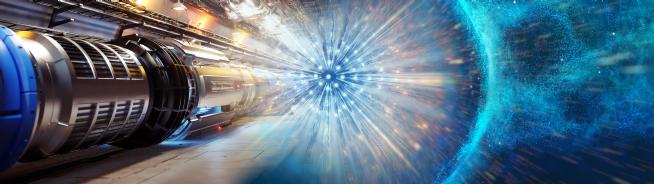
Artistic view of a possible Future Circular collider and of a particle collision (image by: PIXELRISE and CERN)