

Lars Linden's Successful PhD Defense
We congratulate Lars for his successful thesis defense on March 16th 2026
13.03.2026
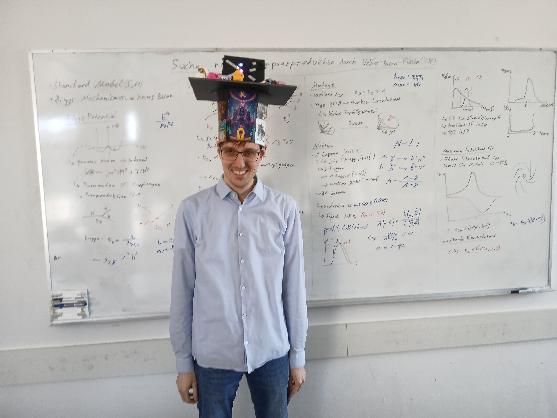
Lars worked on a DiHiggs analysis investigating the Vector Boson Fusion (VBF) production mechanism with a semileptonic bbWW final state targeting a boosted topology. While ATLAS widely studies DiHiggs production via gluon Fusion, VBF production was only investigating in a 4b final state before. However, CMS analyses targeting VBF production were already investigated for bbWW final states. Due to promising results of these analyses, the analysis targeting the semileptonic bbWW final state is introduced in ATLAS.
While introducing the Higgs Boson to the Standard Model solved issue like particle masses, new and interesting challenges were uncovered. These include couplings between Higgs-like particles, the Higgs self-interaction, and a quartic coupling between Vector Bosons and Higgs Bosons. These terms have been predicted by theory but not yet measurement. However, measuring the strength of the couplings would give insight to the exact shape of the Higgs potential.
Lars' analysis aimed at restricting the coupling strength of the quartic coupling between Vector Bosons and Higgs Bosons (κ2V). For this, several values of κ2V have been investigated, where κ2V =1 signifies the Standard Model predicted value. Choosing a boosted topology, where the decay products of Hbb and Whad are rather close, makes the analysis more sensitive to the non Standard Model case. Investigating the VBF Signal events against the most prominent background processes, Lars showed that κ2V can be restricted, proving that the bbWW final state in a boosted topology is indeed sensitive to κ2V.